
A machine that stops, loses recipes, trips a drive or shows false sensor signals needs evidence before it needs a replacement. By tracing the fault through sensors, wiring, logic, communications, safety circuits, actuators and mechanics, you can choose the right remedy and brief an automation provider without paying for avoidable troubleshooting.
Key takeaways
- Compare commanded states with mechanical and utility conditions before calling a provider.
- Choose repair, retrofit, modernization or replacement based on fault scope and obsolescence.
- Demand evidence from comparable projects, not a polished software demonstration.
- Write FAT, SAT and handover tests around real loads, utilities and operating conditions.
Diagnose the fault before you call an automation provider
Start with evidence, not a provider. A control fault changes the commanded state, while a mechanical or utility fault prevents the commanded action; compare both.
1. Intermittent cycle stops: read the PLC diagnostic buffer, alarm timestamps and input-status history, then inspect loose terminals.
2. False sensor signals: compare the input LED with a physical measurement; check sensor alignment, supply voltage and shielding.
3. Stuck outputs: observe forcing restrictions, output-module status, relay contacts and actuator feedback before changing logic.
4. Recipe loss: check HMI storage, PLC memory, user permissions and backup batteries.
5. Drive trips: record the drive fault code, motor current, acceleration settings, incoming voltage and mechanical load.
6. HMI communication alarms: check switch status, cables, IP addresses, controller diagnostics and tag quality. Compare the PLC tag with the physical signal to separate a PLC fault from a SCADA visibility problem.
7. Network versus process fault: review packet or connection diagnostics alongside local device behavior. A healthy local device with failed communications points to the network; a reachable device behaving incorrectly points to the process or control logic.
8. Inconsistent cycle times: compare sequence timestamps and scan-time data with product variation and pneumatic pressure.
Before calling anything random, log voltage dips, earthing, electrical noise, dust, heat, humidity and compressed-air quality. This discipline matters in industrial automation in Pune and across industrial control systems, where utilities can imitate software failures. Take these records to an automation provider.
Choose repair, modernization, retrofit or replacement
Choose the intervention that matches the evidence and the machine’s remaining service life, not the newest available hardware.
| Option | What the evidence shows | Suitable action |
|---|---|---|
| Repair | Failure is isolated; the controller and safety hardware remain supported; source code and replacement parts exist. | Replace the failed component and verify the original sequence. |
| Modernize PLC or HMI | The sequence is sound, but the processor, operating system, display, memory, alarm handling or recipe interface is obsolete. | Preserve tested machine behavior and document every changed tag. |
| Retrofit control panel | Wiring, power distribution, relays, drives or safety devices are unreliable, poorly documented or unable to support new I/O. | Rebuild the panel and verify every circuit and interlock. |
| New machine-control system | The program is corrupt, undocumented, unsafe to modify or incapable of the required cycle, motion or traceability. | Specify new industrial control systems with defined safety and recovery functions. |
| Integrate the full line | Machines need coordinated handshakes, buffering, common safety logic, scheduling or shared recipe and data ownership. | Define line-level architecture and responsibility. |
| Replace machine | Mechanics, guarding, utilities or throughput still limit production after controls are repaired. | Replace the machine rather than extending its controls. |
Before requesting automation engineering services, record:
- Machine make and model, production target and downtime history
- Electrical drawings, safety-circuit drawings and I/O list
- PLC and HMI backups, alarm history and drive parameters
- Network topology, addresses and known operator workarounds
A missing program or undocumented safety circuit is evidence to stop and survey before modifying hardware.
Select an integrator using evidence, not a software demonstration
Compare an industrial automation system integrator by commissioning evidence, not a polished software demonstration. Ask for proof from a similar machine process, supported PLC and HMI platforms, electrical design, safety validation, source-code access, response time, spare-parts strategy, cybersecurity controls, documentation and post-commissioning support.
| Evidence to request | What it proves | Warning sign |
|---|---|---|
| Redlined retrofit drawing | Existing wiring and modifications were controlled | “As-built” drawing is unavailable |
| Representative FAT protocol | Code, panels, HMI, recipes and alarms were tested before shipment | FAT means only a screen demonstration |
| Controller or drive recovery procedure | Production can recover without guesswork | Recovery depends on one engineer |
| Safety-validation records | Guards, emergency stops and safety functions were verified | Safety is left to the machine operator |
| Version-control evidence | PLC, HMI, drive and robot changes are traceable | Source files have no revision history |
Require a responsibility matrix naming the owner for calibration, network switches, safety validation, recipes, production data, utility permissives, operator training and cybersecurity. The site plan must cover survey, risk assessment, functional specification, hardware selection, panel or machine modifications, PLC/HMI development, simulation, FAT, installation, commissioning, SAT, training and handover documentation.
Compare response commitments and spare-part access in writing. An industrial automation company in Pune, including IkodeAutomation |08048033508, belongs on the shortlist only when its documented process, relevant machine experience and support terms match your fault and project scope. Choose ownership and production-risk controls over location.
Related product
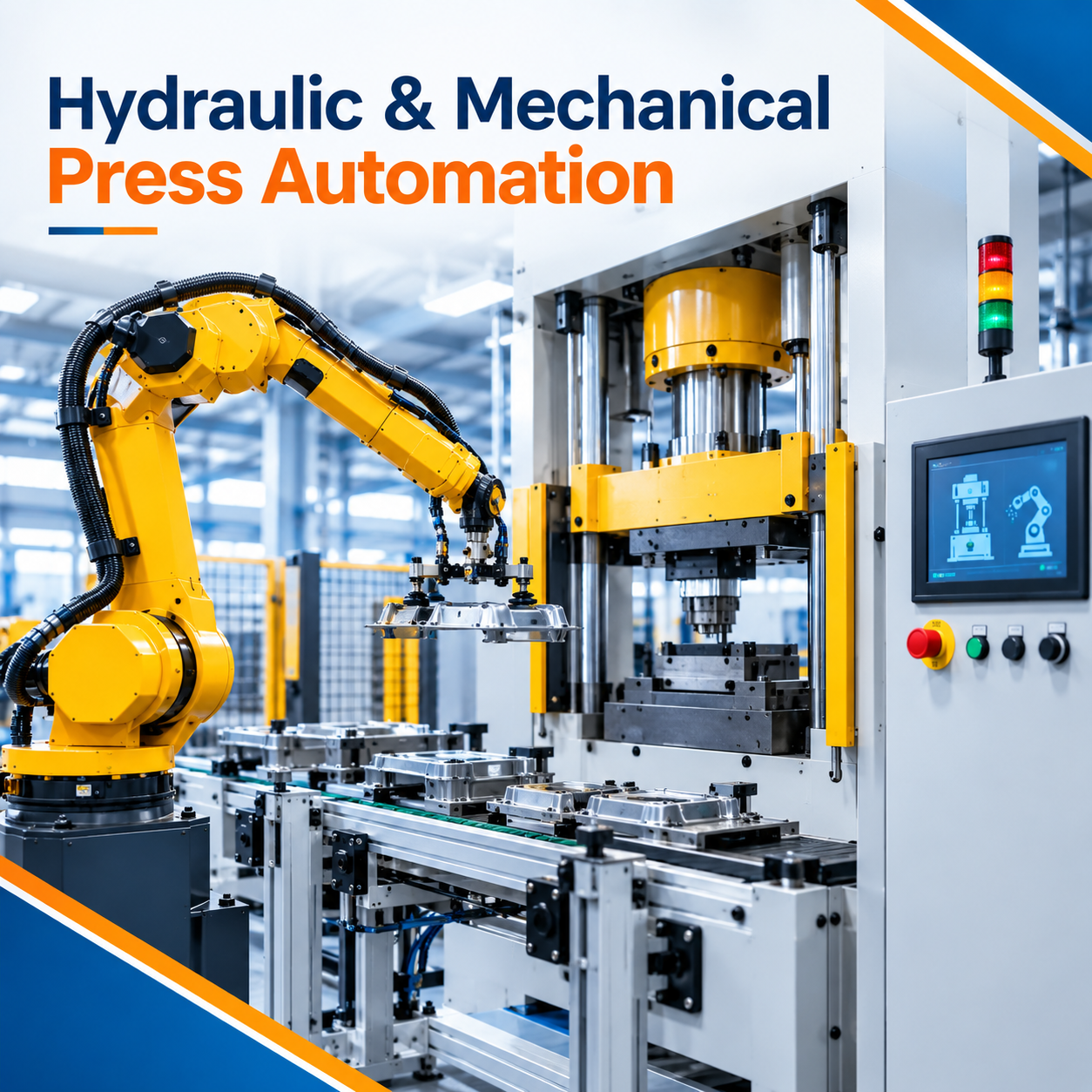 | Industrial Automation Solutions & System Integration Hydraulic & Mechanical Press Automation System Advanced Hydraulic & Mechanical Press Automation Solutions by IkodeAutomation Ikodeautomation provides customized Hydraulic & Mechanical Press... View product → |
Specify the control architecture around real plant conditions
Define the architecture before you choose a PLC, HMI or network switch. Industrial automation in Pune must fit the plant’s actual sequence, utilities and environment, not a demonstration cell.
1. Document the process sequence, existing PLC and HMI platforms, required I/O count, spare capacity, scan-time limit, remote-I/O locations, VFD and servo interfaces, recipe ownership, alarm priorities, historian requirements and expansion allowance. Check voltage dips, earthing, electrical noise, temperature, dust, humidity and compressed-air pressure during the site survey.
2. Create a data dictionary before connecting industrial control systems. Specify tag names, data types, scaling, byte order, timestamps, quality flags, alarm states and failure behavior for every PLC, SCADA, MES and OPC UA connection. Shared protocols do not guarantee shared meaning.
3. Separate control, supervisory and enterprise zones with controlled conduits; never connect a PLC directly to the enterprise network for dashboards. Make remote support plant-approved, individually attributable, time-limited and disabled after the session. Apply NIST SP 800-82 and IEC 62443 principles to segmentation, authentication and remote access.
4. Engineer emergency stops, guards, light curtains, two-hand controls and safe-speed functions separately from sequence logic. Use a risk assessment and the applicable ISO 13849 performance level or IEC 62061 safety-integrity target, then validate protective bonding, disconnects, control circuits and emergency-stop functions against IEC 60204-1.
5. Record failure behavior for controller loss, communication loss, bad sensors and power recovery. This prevents a dashboard alarm, network message or HMI command from being mistaken for a safety function or a safe machine state.
Make FAT, SAT and handover prove the machine works
A commissioned machine stays reliable only when testing proves both the control logic and the plant conditions it will face. Treat the work as a deliverable from your industrial automation system integrator, not as a successful demonstration.
1. Build a controlled I/O database and cause-and-effect matrix. Record every signal’s source, destination, electrical type, normal state, scaling, alarm limits, fail state, tag name and test method.
2. Agree acceptance criteria, test evidence and punch-list ownership before testing. Assign responsibility for calibration, utilities, networks, safety validation, recipes and production data.
3. Use FAT before shipment to check panel wiring, simulated inputs, PLC behavior, HMI screens, recipes, sequences and alarm handling. Record each result.
4. Use SAT at the plant to check field wiring, real instruments, utilities, interlocks, network behavior, safety devices and production-specific performance. FAT does not replace SAT.
5. Test power recovery, controller failure, drive replacement, communication loss, bad sensor states, recipe backup and safe restart. A system that works only under ideal conditions is not accepted.
6. Make handover recoverable: require backed-up PLC, HMI, drive and robot programs, revision history, IP and network records, electrical and pneumatic drawings, licenses, plant-controlled passwords, spare-part recommendations and recovery procedures.
Train operators and maintenance staff, synchronize clocks, define equipment hierarchy and downtime reason codes, and set rules for missing or manually entered data before trusting OEE or traceability reports.
Apply change control to firmware, patches, recipes and security settings; untested IT updates must not threaten availability or safety.
Frequently asked questions
How do you diagnose a factory automation fault before calling an integrator?
Compare the commanded state with the physical result. A control fault changes the command, while a mechanical or utility fault prevents the commanded action. Check PLC inputs and outputs, interlocks, sensors, actuators, power, air pressure and utilities before requesting automation engineering services.
When should you repair, modernize, retrofit or replace an industrial control system?
Repair a contained failure with available, supported parts. Modernize when the architecture still suits production but software, drives, HMIs or networks are obsolete. Retrofit when you need new controls on an existing machine. Replace the system when safety, capacity, supportability or core hardware limits cannot be resolved economically.
How should you select an industrial automation system integrator in Pune?
Ask for evidence from comparable machines, including drawings, test records, commissioning results, references and support arrangements. Evaluate the integrator's troubleshooting method, documentation quality and ability to work with your plant conditions instead of relying on a software demonstration.
What should a factory automation control specification include?
Define the control architecture around actual production conditions: machine sequence, I/O, safety functions, PLC and HMI platform, drives, industrial networks, utilities, environmental conditions, data requirements, maintenance access and fault recovery.
What do FAT, SAT and handover need to prove?
FAT must test the programmed sequence, alarms, interlocks, safety logic and communications before shipment. SAT must repeat critical tests on the installed machine with real utilities and operating conditions. Handover must include approved drawings, backups, source files, manuals, test results, training records and a clear list of open items.