

A Factory Acceptance Test gives you documented evidence that an automation system matches its approved design before shipment, but a demonstration is not enough. You will be able to define the test scope, distinguish workshop checks from site validation, and compare FAT providers using concrete records, safety controls and acceptance criteria.
Key takeaways
- Match every FAT test to an approved functional specification.
- Record PLC, HMI, SCADA, drive and safety test evidence.
- Separate FAT findings from SAT, commissioning and final validation issues.
- Compare providers by protocols, witness support and project closeout discipline.
What FAT proves before an automation system leaves the workshop
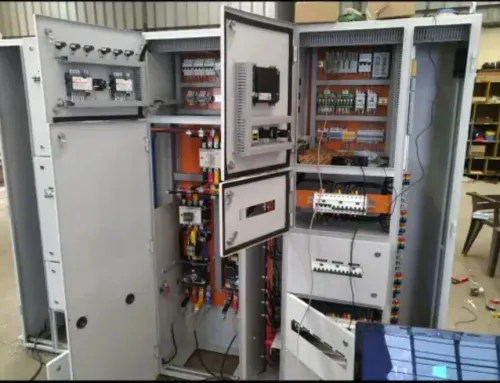
A Factory Acceptance Test (FAT) is the documented, witnessed check performed at the automation builder’s workshop before shipment or site installation. A FAT in Pune proves that the assembled panel, PLC, HMI, SCADA, remote I/O, drives and safety controls match the approved functional specification.
It can demonstrate logic, wiring, graphics, alarms, sequences, reports, communications and simulated field responses. It cannot prove actual sensor installation, cable routing, utilities, motor rotation or production throughput.
| Stage | What it proves | Where it happens |
|---|---|---|
| FAT | The built system behaves against approved test cases | Integrator’s workshop |
| SAT | The installed system communicates and operates with site equipment and infrastructure | Customer’s site |
| Commissioning | Equipment is made ready through energisation, loop checks, tuning and controlled operation | Customer’s site |
| Production validation | The process achieves required output, quality and repeatability with real material | Live production |
Use this FAT workflow:
- Review the approved protocol, freeze drawings and software versions, inspect panel wiring, then energise under controlled conditions.
- Execute each test case for normal and abnormal states, including permissive failure, interlock action, emergency stop, communication loss, power restoration, instrument failure and safe restart.
- Record the expected result, observed result, pass or fail status, evidence, tester and client witness signatures. Log every exception as a punch item.
- Sign off only with agreed closure dates, as-built drawings, backups, calibration records and handover links to SAT.
Loop checking, dry-run testing and site utility verification remain site activities; a successful FAT does not replace them.
How to prepare the FAT protocol and evidence pack
The approved FAT protocol, not an integrator’s standard checklist, governs the witness session. It must trace every functional-specification requirement to a test case, identify customer witnesses, and define pass, fail, deviation, retest and closure rules.
Before factory acceptance testing in Pune begins, issue one controlled dossier containing:
- Approved functional specification, cause-and-effect matrix, sequence descriptions and approved change log
- Panel schematics, cabinet layout, I/O list, instrument index, network architecture and alarm list
- FAT schedule, witness matrix, risk assessment, calibration certificates and test-equipment certificates
- Blank test sheets, exception register, punch-list register and acceptance certificate
- Handover index covering as-built drawings, training records, backups and SAT prerequisites
Every test case needs a unique ID, requirement reference, preconditions, test steps, expected result, observed result, pass/fail status, evidence reference, tester name and customer-witness signature. Record the date, test environment and retest number; a screenshot without that context is weak evidence.
Freeze the tested baseline before energisation. Record PLC and safety-logic revisions, HMI or SCADA version, drive and instrument parameter files, panel drawings, network settings, recipes, alarm configuration and complete backup images. A code change after testing requires impact review and a rerun of affected cases.
Signal simulation must be explicit:
| Method | Evidence provided | Record in the case |
|---|---|---|
| Software-forced value | Logic response only | Force tag, user and reset |
| Calibrated electrical simulator | Panel input and scaling | Signal type, value and certificate |
| Real instrument | Instrument-to-panel path | Instrument ID, range and connection |
Separate a design deviation from a failed test. Accept a deviation only with an owner, due date, impact assessment and closure evidence, then link the signed dossier to SAT and final acceptance.
How to execute controls, safety and software tests
Run each FAT case against the approved functional specification, using simulated field conditions and preserving the exact tested PLC, safety, HMI/SCADA, drive and network configuration. Industrial automation testing in Pune must prove both the expected response and the safe response to failure.
1. Inspect the panel before energising it. Check labels, terminal tightness, protective bonding, protective-circuit continuity and insulation-related results under IEC 60204-1. Record these electrical checks separately from software tests.
2. Verify every I/O point from terminal to screen: digital states, analog scaling, remote-I/O diagnostics, drive commands, feedback, instrument failure values and output fail states. Test missing and implausible signals.
3. Run normal and abnormal sequences. Remove permissives, trigger interlocks, interrupt a partial cycle, test operator login restrictions, and confirm alarms show the correct text, priority, timestamp, acknowledgement and return-to-normal behaviour.
4. Test each safety function end to end: initiating device, safety logic, output device, feedback monitoring, reset and fault reaction. Prove the required performance level or safety integrity level; an HMI message alone is not evidence.
5. Interrupt PLC, HMI, SCADA, remote-I/O, drive and higher-level communications. Check timeout, stale-data indication, node restart and recovery after network loss without an unsafe automatic restart.
6. Load recipes, edit authorised values, reject invalid limits, run a batch, and verify saved values and reports. Remove and restore power, then confirm the restart state, retained data and manual recovery path.
Close every failure with evidence and retest against the unchanged baseline. Availability, process material and site wiring remain SAT matters.
Which checks belong in FAT, SAT, commissioning and final validation
A workshop FAT can prove the engineered system behaves as specified under controlled, simulated inputs. It cannot prove that a field instrument is installed correctly, a motor turns the right way, or the process achieves its required output.
For fat in pune, use the approved protocol as the boundary between evidence available before shipment and evidence that must wait for the customer’s site.
| Stage | Prove at the workshop | Require the customer’s site |
|---|---|---|
| FAT | Panel wiring, PLC and safety logic, HMI and SCADA screens, alarms, sequences, recipes, reports, simulated I/O, communications faults, backup and restore | Actual field-loop continuity, sensor installation, cable routing, utilities, motor rotation, equipment alignment and plant interlocks |
| SAT | Installed panel energisation, network integration, field-device response, loop checks, utility permissives and site-specific interlocks | Production conditions that cannot be reproduced safely or accurately in the workshop |
| Commissioning | Controlled dry-run sequences and simulated recovery behaviour | Calibration, tuning, live actuator movement, utility pressure or flow, equipment coordination and safe operation with connected machinery |
| Final validation | Approved test records and resolved FAT or SAT deviations | Production material, validated recipe, throughput, quality results, operator workflow and performance at the customer’s defined operating conditions |
Industrial automation testing in pune should record each boundary in the test sheet, including the requirement reference, observed result, evidence, witness and open action. Do not mark a simulated response as a completed field check. Tie FAT sign-off to SAT entry criteria, and hold final acceptance until site and production evidence is complete.
How to compare automation FAT services and close the project
Demand evidence, not a two-hour demonstration, from providers of automation FAT services in Pune. The commercial scope should name the approved functional specification, software revision, test protocol, witness signatures, punch-list rules, backup format and the handover gate linked to SAT.
Compare bids against these deliverables:
- Signed test sheets showing test-case ID, requirement reference, observed result, evidence and client witness.
- An exception register identifying each owner, severity, due date, retest result and closure evidence.
- As-built electrical drawings, I/O lists, network layouts, calibration records and operator or maintenance training records.
- Restorable PLC, HMI, SCADA, safety-controller and drive backups, including software versions, licenses, passwords and configuration exports.
- Abnormal tests covering permissive failure, interlock, emergency stop, power recovery, instrument failure, communication loss, restricted login and interrupted-sequence restart.
- A signal-simulation record stating whether each critical input used a software force, calibrated electrical simulator or real instrument.
| Provider offer | Accept only if | Reject if |
|---|---|---|
| Witnessed demonstration | Signed sheets and failed-test retests are included | Results exist only in presentation slides |
| Punch-list closure | Critical safety and control items block sign-off; every open item has an SAT owner and due date | “Open” items have no classification or transfer record |
| Backup and drawings | Files are tested by restore and match the as-built panel | A USB handover contains unverified copies |
| SAT handover | FAT exclusions identify site loops, utilities, rotation, alignment and production trials | FAT sign-off is treated as site acceptance |
For factory acceptance testing in Pune, sign only after the agreed FAT exit criteria are met. Carry each transferred punch item into the SAT register, then issue final acceptance after site evidence closes it; this prevents a workshop signature from hiding a field failure. IkodeAutomation |08048033508 can be assessed using this same evidence-based checklist.
Frequently asked questions
What does a FAT prove before an automation system leaves the workshop?
It proves that the assembled panel, PLC, HMI, SCADA, remote I/O, drives and safety controls match the approved functional specification before shipment.
What should an automation FAT protocol and evidence pack contain?
Include test steps, expected results, acceptance criteria, instrument details, software versions, test records, photographs, punch-list items and approval signatures.
Which tests should be executed during an automation FAT?
Test control sequences, I/O mapping, HMI screens, alarms, trends, drives, interlocks, emergency stops, safety circuits, fault recovery and communications.
What is the difference between FAT, SAT, commissioning and final validation?
FAT checks the system at the builder’s workshop; SAT checks site installation and interfaces; commissioning proves operational readiness; final validation confirms documented performance against project requirements.