
A scheduled automation maintenance visit should produce more than a quick panel check or a list marked “system normal.” You will be able to follow each stage of the visit, check whether testing was safe and complete, and judge whether the final report gives you usable evidence for the next maintenance decision.
Key takeaways
- Review the asset list, failure history, drawings and shutdown requirements before arrival.
- Confirm isolation, lockout/tagout and online versus shutdown work at site entry.
- Test PLC, HMI, SCADA alarms, VFD operation, wiring, backups and panel cooling.
- Leave with measured results, faults found, actions completed and next-service recommendations.
How is the AMC visit scheduled and prepared before arrival?
The technician should arrive with an asset list, failure history, drawings and an agreed work window—not begin by identifying the equipment from labels. The industrial automation AMC service process in Pune starts with a scope review that separates online checks from work requiring shutdown, isolation and lockout/tagout.
1. Confirm the affected machine, production symptom, alarm time, operating conditions and business impact with the authorised plant contact.
2. Review electrical drawings, PLC and HMI program backups, PLC, remote-I/O, SCADA, VFD, safety-system and network details, including firmware versions, IP addresses and program ownership.
3. Check previous service reports, alarm history, VFD stored faults and trends, parameter backups, spare-parts availability, and open defects. A drive that runs during arrival can still show intermittent overtemperature, undervoltage, earth-fault or communication faults in its history.
4. Agree the permitted maintenance window, isolation points, lockout/tagout procedure, responsible electrical person, access rules, permits and emergency contact. Confirm whether online diagnostics are allowed when production cannot stop.
5. Read the automation annual maintenance contract to confirm response time separately from restoration time, and identify charges or exclusions for remote support, shutdown work, programming, engineering changes, travel, night work and replacement parts.
6. Record Pune site conditions that affect inspection: panel dust, blocked filters, high ambient temperature, monsoon humidity, condensation, damaged cable glands and exposed terminals.
Before travelling, confirm panel locations, machine readiness, required software access, laptop or programming-cable needs, visitor documentation and the parts to carry. This prevents a visit from ending with diagnosis but no safe repair.
What happens when the technician enters the site?
The technician begins with an on-site meeting, not an immediate repair. An authorised production contact and electrical or maintenance representative identify the affected machine, describe the operating symptom, and agree what the technician is allowed to inspect or change.
- Machine identity: confirm the asset tag, production line, PLC panel, HMI station, VFD or field device involved.
- Symptom: record the exact alarm, failure condition, affected operating mode, time of occurrence and recent change or intervention.
- Safety controls: confirm the plant’s isolation procedure, authorised lockout/tagout personnel, emergency-stop status and boundaries around adjacent equipment.
- Maintenance window: record the approved start and finish time, production constraints, permit requirements and person authorised to release the machine.
Work inside a production-connected or energised panel does not begin until the agreed controls are active. For a shutdown, the team isolates the equipment, applies locks and tags, and verifies absence of voltage before opening the enclosure.
If shutdown is not authorised, the technician limits the work to approved online diagnostics and records the tests that cannot be performed safely. The meeting also sets the restoration plan: who will remove isolation, who will run the machine, and which permissives, interlocks and emergency-stop functions must be checked before production resumes.
This disciplined entry process keeps industrial automation maintenance in Pune tied to the actual fault and the site’s permitted risk controls.
What is checked inside the control panel and PLC system?
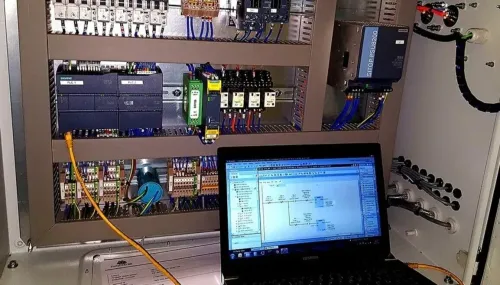
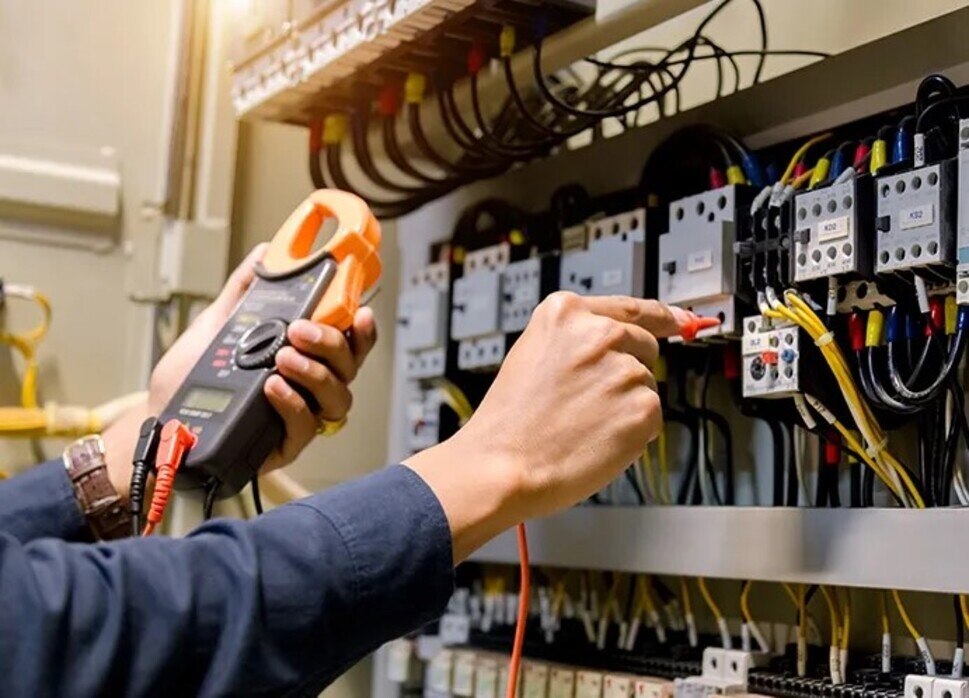
A technician starts with safety, not fault codes. For industrial automation maintenance in Pune, the approved shutdown window determines whether the panel is isolated or diagnosed online. Inside an isolated panel, the technician applies lockout/tagout, verifies absence of voltage with a rated tester, and restores power only through a controlled sequence.
The inspection follows a repeatable order:
- Record the as-found condition: controller and drive fault histories, panel temperature, battery status, fan and filter condition, network errors, backup status, and visible wiring defects.
- Inspect the cabinet for dust, moisture, condensation, loose ferrules, overheated terminals, damaged cable glands, poor earthing, and restricted airflow. High temperature reduces power-supply and drive margin.
- Compare the running PLC program, hardware configuration, and remote-I/O map with the approved backup. A mismatch identifies an unauthorised change or an incomplete restoration, not automatically a failed controller.
- Check the 24 VDC supply at the power supply and at remote-I/O terminals under load, including fuse condition, voltage drop, ripple, and controller battery status.
- Trace communication faults through module LEDs, switch port status, cable shielding, termination, diagnostic counters, node addresses, and loss-and-recovery tests.
The technician then links the alarm timestamp to PLC diagnostics, I/O status, measured voltages, sequence conditions, and recent changes. A single “I/O fault” alarm cannot distinguish a broken field wire from a failed module or missing power.
Critical interlocks are tested against an agreed procedure, with bypasses controlled and documented. Alarm evidence and measurements belong in the as-found report.
How are HMI, SCADA and VFD functions tested?
A live screen proves only that the display loads. Testing must show that commands reach the PLC, process values return, alarms behave correctly, and the machine remains controllable under production load.
1. Open every critical PLC HMI screen and compare displayed status, setpoints, interlocks and trends with field conditions. Enter a controlled test value, confirm the PLC receives it, and verify that permissions prevent unauthorised changes.
2. Trigger approved alarm conditions one at a time. Check the alarm text, priority, timestamp, audible indication, acknowledgement, return-to-normal message and alarm history. Confirm time synchronisation, historian writes, report generation and user access; disconnect the network to test alarm behaviour during communications loss and recovery.
3. Test SCADA commands, screen navigation, live trends and server-to-PLC communications from the operator workstation. Confirm that a failed connection shows a clear stale-data or communications alarm instead of displaying old values as current.
4. During VFD maintenance service in Pune, review stored overtemperature, undervoltage, earth-fault and communications codes alongside operating trends. Inspect fan and heatsink condition, DC-bus indication, terminals, control wiring, braking components and the parameter backup.
5. Run each critical motor through start, stop, speed reference, ramp and direction checks, then repeat under its normal process load. Compare commanded speed with feedback, motor current and process response; a drive that runs unloaded can still fail during acceleration or sustained load.
6. Include a recovery demonstration in the PLC HMI SCADA AMC in Pune. Restore a critical PLC, HMI/SCADA node or VFD from retained files, then verify versions, licences, drivers and automatic operation; file existence alone proves nothing. Treat any software or firmware change as controlled work with a tested rollback and acceptance test.
What should you receive at handover and in the AMC report?
Do not approve the visit until the machine passes a documented return-to-service check and you can recover its critical controls from retained files. The handover should separate completed work, failed tests, documented changes and remaining risks.
1. Run the machine through manual, automatic and emergency-stop sequences with the authorised operator. Confirm guards, interlocks, permissives, alarms, alarm acknowledgement, alarm history, time synchronisation, historian writes, reports and user permissions. Test behaviour after communication loss and recovery.
2. Request a backup package, not just a PLC upload. It should contain the PLC project and hardware configuration, HMI/SCADA application, tag database, communication settings, recipes, access information, firmware and software versions, drive parameter files, and revision dates.
The report must state which replacement PLC, HMI/SCADA node or VFD was restored from those files and whether automatic operation resumed safely.
3. Check the change log against the pre-work files. Record every logic edit, screen change, alarm adjustment, parameter change, operating-system or runtime update, database or driver version, licence detail and modified drawing. A screen export alone cannot prove recoverability.
4. Record open faults with risk, owner, parts, target date and operating restriction. For VFD maintenance service in Pune, include stored fault codes, trends, cooling, DC bus, terminals, braking components and parameter backup.
An automation annual maintenance contract must also show response time separately from restoration time, plus exclusions for programming, shutdown support, travel, night work and parts. Providers such as IkodeAutomation 08048033508 should leave these records clear enough for your next PLC HMI SCADA AMC in Pune review.
Related product
 | Industrial Automation Solutions & System Integration PLC, HMI, SCADA & VFD Maintenance Industrial Automation AMC Services AMC Work – Annual Maintenance Contract Services-Reliable Industrial Automation Support for Uninterrupted Operations Ikodeautomation provides... View product → |
Frequently asked questions
How is an industrial automation AMC visit scheduled in Pune?
The visit is prepared using an asset list, failure history, electrical drawings and an agreed work window. Separate online checks from tasks requiring shutdown, isolation and lockout/tagout.
What does a technician check inside a PLC control panel?
The technician checks PLC health, power supplies, terminals, wiring, communication links, input and output status, program backups, panel cooling, dust and signs of overheating or loose connections.
How are HMI, SCADA and VFD functions tested during AMC?
The technician verifies screen commands, alarms, trends, tags and communication for HMI and SCADA. VFD checks include run and stop commands, speed reference, fault history, motor feedback, parameters and protective trips.
What should an AMC report contain at handover?
Request the completed checklist, measured readings, faults found, corrective work, replaced parts, backup files, photographs, pending risks, recommended actions and the next service date.