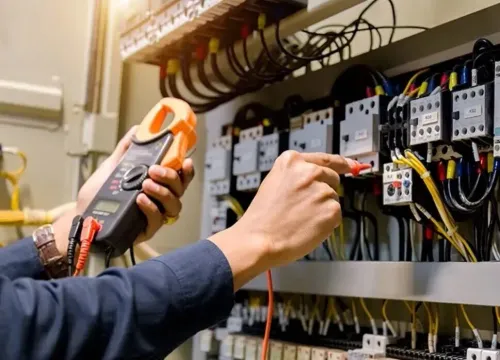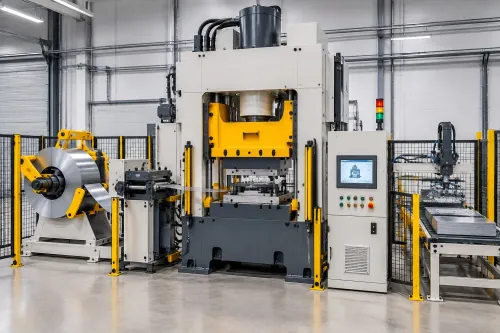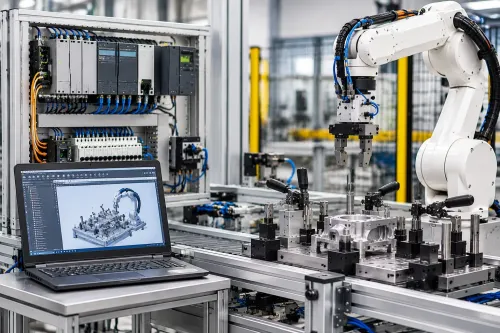

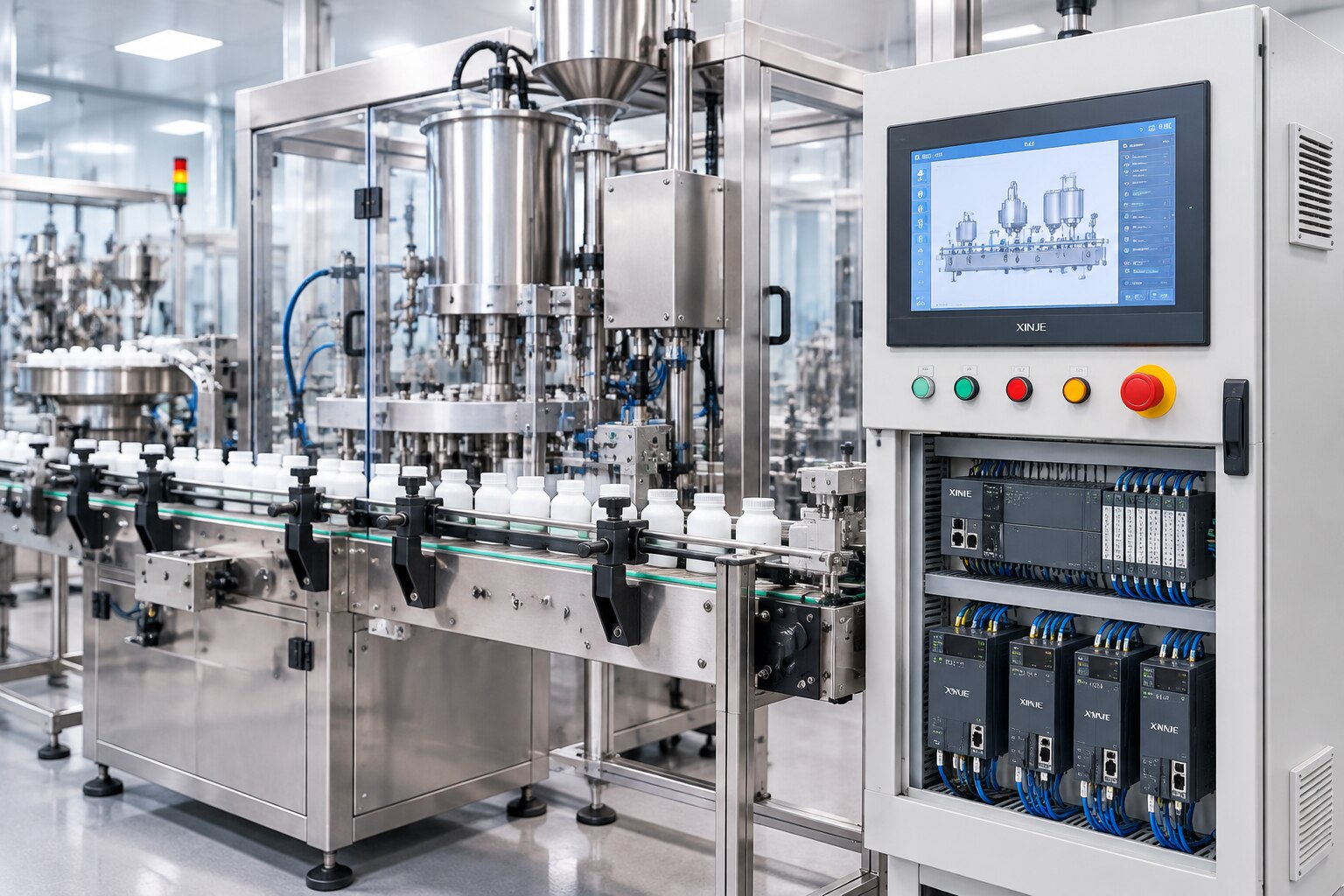
Pharmaceutical equipment in Pune needs more than a PLC, HMI and servo drive: the selected architecture must support clean machine control, reliable data exchange, validated records and recoverable maintenance. By the end, you will be able to match XINJE hardware to a process, compare it with established alternatives, test compliance requirements and specify the integrator deliverables before procurement.
Key takeaways
- Match the XINJE CPU to motion, I/O, recipe and safety demands.
- Compare programming, support, lifecycle and validation—not only PLC purchase price.
- Use HMI permissions, alarms and audit-ready records to control production.
- Specify commissioning documents, backups, spares and replacement procedures before handover.
Match the XINJE PLC architecture to the pharmaceutical machine
A liquid filler with servo dosing, recipe control and safety interlocks needs more than a point-count estimate. Specify the XINJE family, exact CPU part number, execution time, retained memory method, expansion limit, I/O spare capacity, software version and replacement CPU before approving the panel.
| Machine | Suitable architecture | I/O and communications |
|---|---|---|
| Liquid filling | XD modular PLC; use XDM where coordinated servo motion is central | Distributed digital I/O, analog pressure or flow inputs, servo network, Modbus TCP or RTU after model verification |
| Blister packing | XD or XDM for indexing, web handling and reject timing | High-speed inputs, pulse or motion outputs, local I/O near the machine and Ethernet diagnostics |
| Cartoning and labelling | XC for compact, low-axis equipment; XD for multiple conveyors and servos | Photoeyes, encoders, pneumatic valves, printer interface and spare points |
| Inspection | XD for machine sequencing; keep vision processing in the vision controller or industrial PC | Trigger, result and reject-handshake I/O; define the data protocol and fault timeout |
| CIP/SIP skid | XD with analog and remote I/O; use a separate validated process or utility PLC when scope demands it | Temperature, pressure, conductivity and flow inputs, valve feedback, Modbus devices and historian gateway |
Reserve 15–20% physical I/O and document channel type, signal range, isolation and terminal location. A xinje industrial automation plc in pune specification should also identify RS-485 wiring, Ethernet topology, time synchronisation, backups and the exact register map. Do not assume a working status screen proves reliable recipe, alarm or historical-data exchange.
Compare XINJE with Siemens, Mitsubishi, Omron and Allen-Bradley
Compare the platforms against the machine’s required I/O, execution time, motion functions, protocols and recovery plan—not catalogue point counts. For pharma automation in Pune, obtain the exact CPU, firmware, programming-software version, expansion limits, spare part and local support commitment before accepting a quotation.
| Platform | Compare on | Practical decision question |
|---|---|---|
| XINJE | Lower entry cost, required I/O, Ethernet protocols, motion and documented backups | Can the integrator prove cycle-time performance, restore the project and supply matching spares? |
| Siemens | TIA Portal familiarity, broad diagnostics, PROFINET and plant integration | Does the larger ecosystem justify its licence and hardware cost? |
| Mitsubishi | Fast machine control, motion options and CC-Link family | Will the chosen communications hardware match the plant standard? |
| Omron | Compact machine control, EtherCAT options and traceable diagnostics | Can local programmers and service staff support the installed version? |
| Allen-Bradley | Studio 5000 familiarity, EtherNet/IP and North American standards | Is its lifecycle and plant-network fit worth the premium? |
Keep the PLC and HMI responsible for deterministic sequencing, interlocks, recipes and operator actions. Put SCADA, the historian, MES and ERP behind defined interfaces; do not make the PLC carry batch analytics or business transactions.
Separate machine-control traffic from plant and business networks with managed switches, firewalls, documented IP addresses and approved ports. Require time synchronisation, role-based access, audit trails, backups and a tested restore procedure.
A XINJE PLC/HMI is not itself 21 CFR Part 11 or EU GMP Annex 11 compliance; validate the complete implemented system for its intended records and signatures.
Use the HMI for controlled operation and trustworthy records
Yes, a XINJE PLC-HMI system can support recipes, role-based access, alarms, trends, electronic signatures, audit trails and electronic records, but the hardware alone is not compliant. A XINJE PLC HMI in Pune must be configured, documented and validated for its intended pharmaceutical use.
For 21 CFR Part 11, compliance applies to the implemented electronic-record and signature system, not to a particular PLC, HMI or integrator. EU GMP Annex 11 likewise requires validated computerized systems, data-integrity controls, security, risk management, continuity and controlled changes.
Specify these controls before approving the design:
- Individual accounts with role-based permissions for operators, supervisors, maintenance and administrators
- Recipe version control, approval status, effective dates and reason-for-change capture
- Attributable alarm acknowledgement, setpoint changes, batch decisions and electronic signatures
- A computer-generated, protected audit trail that records user, timestamp, old value and new value
- Time synchronisation across PLC, HMI, server and historian, with controlled clock changes
- Independent backup, restore testing, archived project files and documented software versions
An HMI recipe screen is not automatically an electronic batch-record system. If a setpoint affects product quality, preserve the approved value and its change history outside volatile PLC memory.
Verify the selected models’ exact protocol support and register map. Modbus RTU over RS-485 or Modbus TCP over Ethernet can display status while still failing to exchange recipes or historical data reliably. Require password procedures, firmware records, locally held spares and a witnessed recovery test before handover.
Size XINJE servo automation from the real motion profile
Engineer each xinje servo automation axis from its real motion profile, not from motor power alone. A motor that survives an empty-machine trial can stall when product viscosity, filled-vessel weight, tooling friction or payload changes.
Calculate:
- Peak and continuous torque, including acceleration, deceleration and static load
- Reflected inertia from couplings, gearboxes, screws, augers and tooling
- Speed range, duty cycle, gearbox efficiency and thermal loading
- Braking energy, vertical-axis load and the drive’s regeneration limits
- Encoder resolution, following-error tolerance and required stopping distance
| Axis | Profile to model | Critical check |
|---|---|---|
| Dosing | Repeated acceleration, dwell and precise stop | Torque margin and repeatability at filled volume |
| Indexing | High acceleration followed by settling | Inertia, jerk and stopping error |
| Auger control | Variable speed under changing product resistance | Continuous torque and low-speed stability |
| Web handling | Tensioned roll with changing diameter | Inertia, unwind torque and tension response |
| Conveyor synchronisation | Electronic gearing to a master conveyor | Encoder resolution, phase error and registration |
| Pick-and-place | Fast transfer with changing payload | Peak torque, settling time and vertical braking |
| Reject mechanism | Short stroke with a fixed decision point | Response delay, stop position and safe recovery |
Tune the axis with filled vessels, production-speed material and worst-case payload. Check acceleration and deceleration limits, following-error alarms, homing repeatability, emergency-stop stopping behaviour and recovery after power interruption; an empty-machine pass proves little. Specify each axis, gearbox, encoder, drive and replacement part separately so an “automation package” does not hide responsibility for motion defects.
Specify validation, commissioning and lifecycle support from the integrator
Require the XINJE automation integrator to separate supply, panel fabrication, programming, machine integration, validation documentation, commissioning, training and post-warranty support in the specification. An undefined “automation package” makes defects, change control and requalification disputes difficult to resolve.
- Record the exact PLC family, CPU part number, I/O types and counts, scan requirement, expansion limits, communications ports, memory-retention method, firmware and programming-software versions.
- Approve the control narrative, functional specification, I/O list, alarm philosophy, cause-and-effect matrix, network architecture and software version record against a documented risk assessment.
- Use FAT at the integrator’s site to check assembled panels, sequences, alarms, recipes, interlocks and agreed requirements before shipment; use SAT in Pune to verify installation, utilities, interfaces and production operation.
- Base IQ/OQ support on approved risk-based test scripts, not on a second FAT. Define deviations, evidence, approvals and change-control records.
- Require encrypted or access-controlled source-code and HMI backups, password procedures, firmware records, project-file archives and a tested restore procedure.
- Hold locally available critical spares: CPU, power supply, communication modules, HMI, I/O cards, servo drive and fuses, each with replacement part numbers.
- Include operator and maintenance training, troubleshooting guides, escalation contacts and response times for post-installation recovery.
For pharma automation in Pune, test recovery by replacing a failed component and restoring the approved project before handover. IkodeAutomation |08048033508 should be assessed against these deliverables rather than judged by panel price alone.
Related products
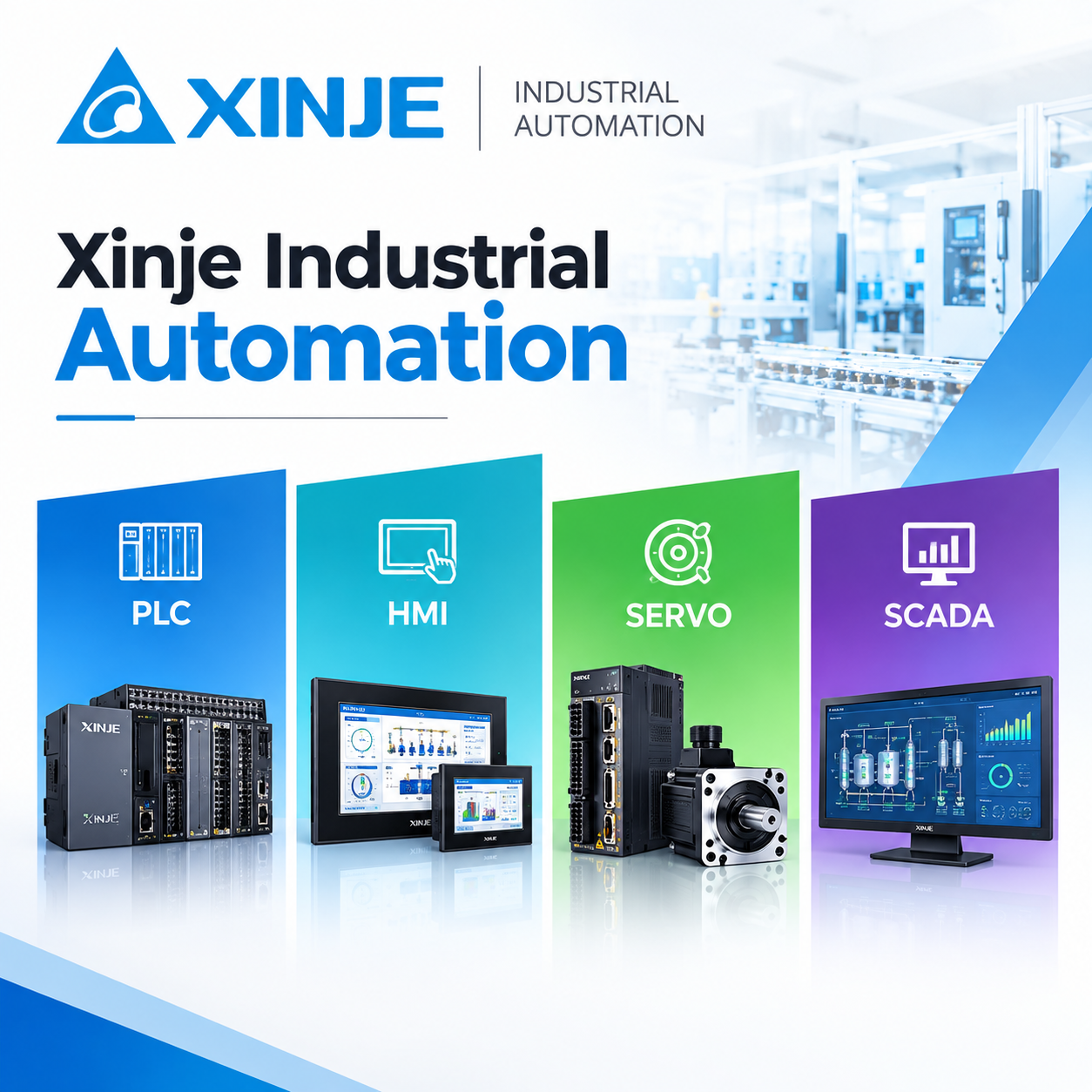 | Component Sales and Services PLC, HMI, Servo & Automation Solutions XINJE Industrial Automation IkodeAutomation – XINJE Industrial Automation Solutions is one of the best choices for XINJE industrial automation solutions in India, providing... View product → |
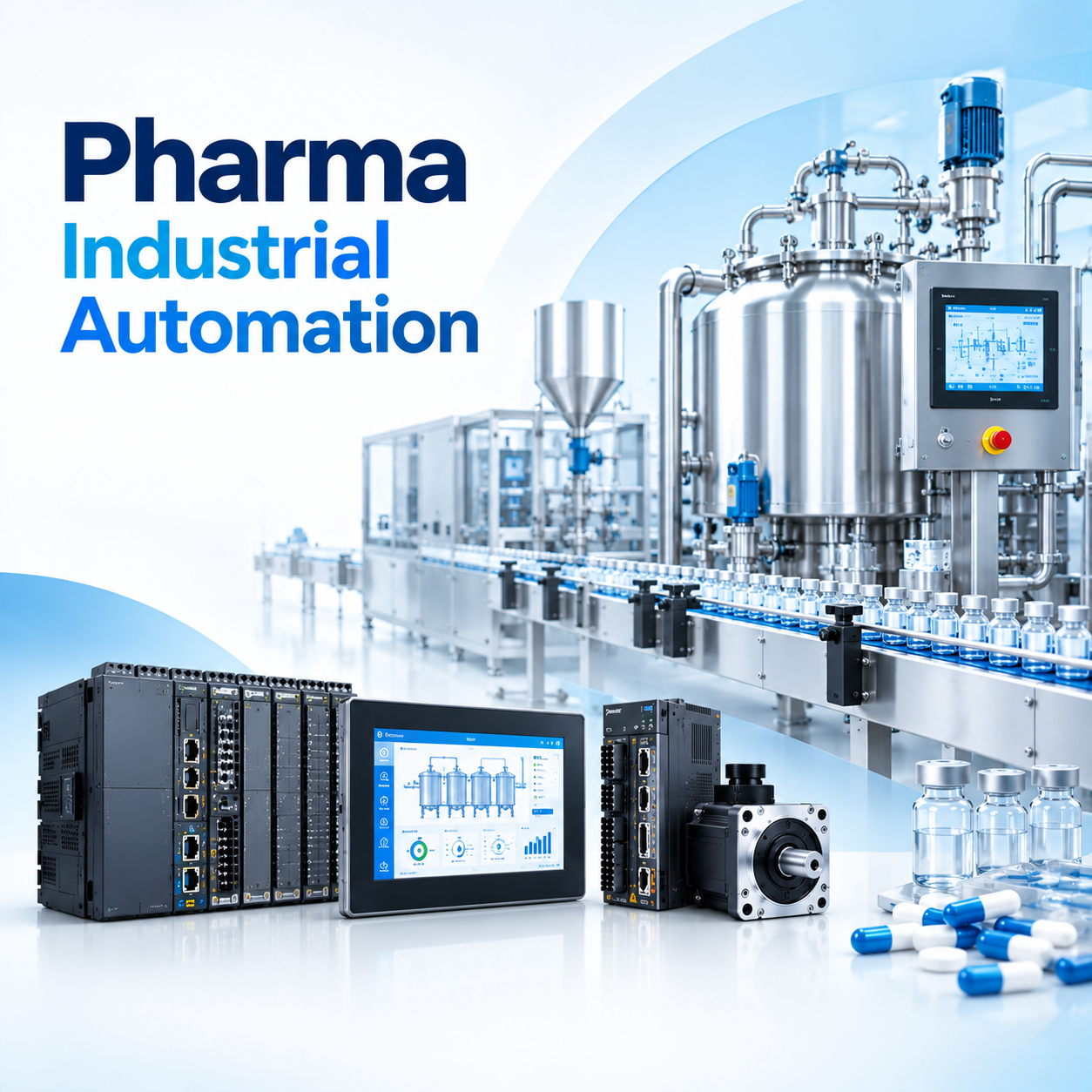 | Industrial Automation Solutions & System Integration Pharma Industrial Automation System Smart, Reliable & Scalable Automation for Pharmaceutical Manufacturing Ikodeautomation is one of the best industrial automation solution providers... View product → |
Frequently asked questions
How do you match XINJE PLC architecture to a pharmaceutical machine?
Define the machine’s I/O, servo axes, scan-time requirement, recipes, retained data, safety interlocks and expansion needs before selecting the exact XINJE CPU, modules and replacement strategy.
How does XINJE compare with Siemens, Mitsubishi, Omron and Allen-Bradley?
Compare the complete automation platform: PLC performance, motion control, HMI tools, safety options, programming environment, local engineering support, spare availability and validation documentation—not just the controller price.
What should a pharmaceutical HMI control and record?
Use named user permissions, recipe selection controls, alarm history, setpoint limits, status screens, electronic records and change tracking that support consistent operation and review.
How should you size XINJE servo automation?
Use the real motion profile, including load, speed, acceleration, deceleration, cycle time, indexing accuracy, torque demand and duty cycle, then select the servo motor, drive and mechanical transmission.
What should an integrator provide for XINJE pharma automation?
Require an approved design, software backups, I/O lists, electrical drawings, commissioning records, test protocols, operator training, validation support, spare-parts guidance and a defined lifecycle service plan.