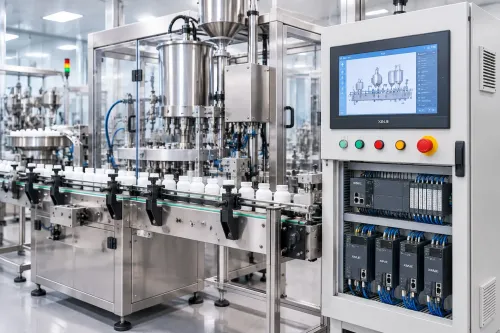

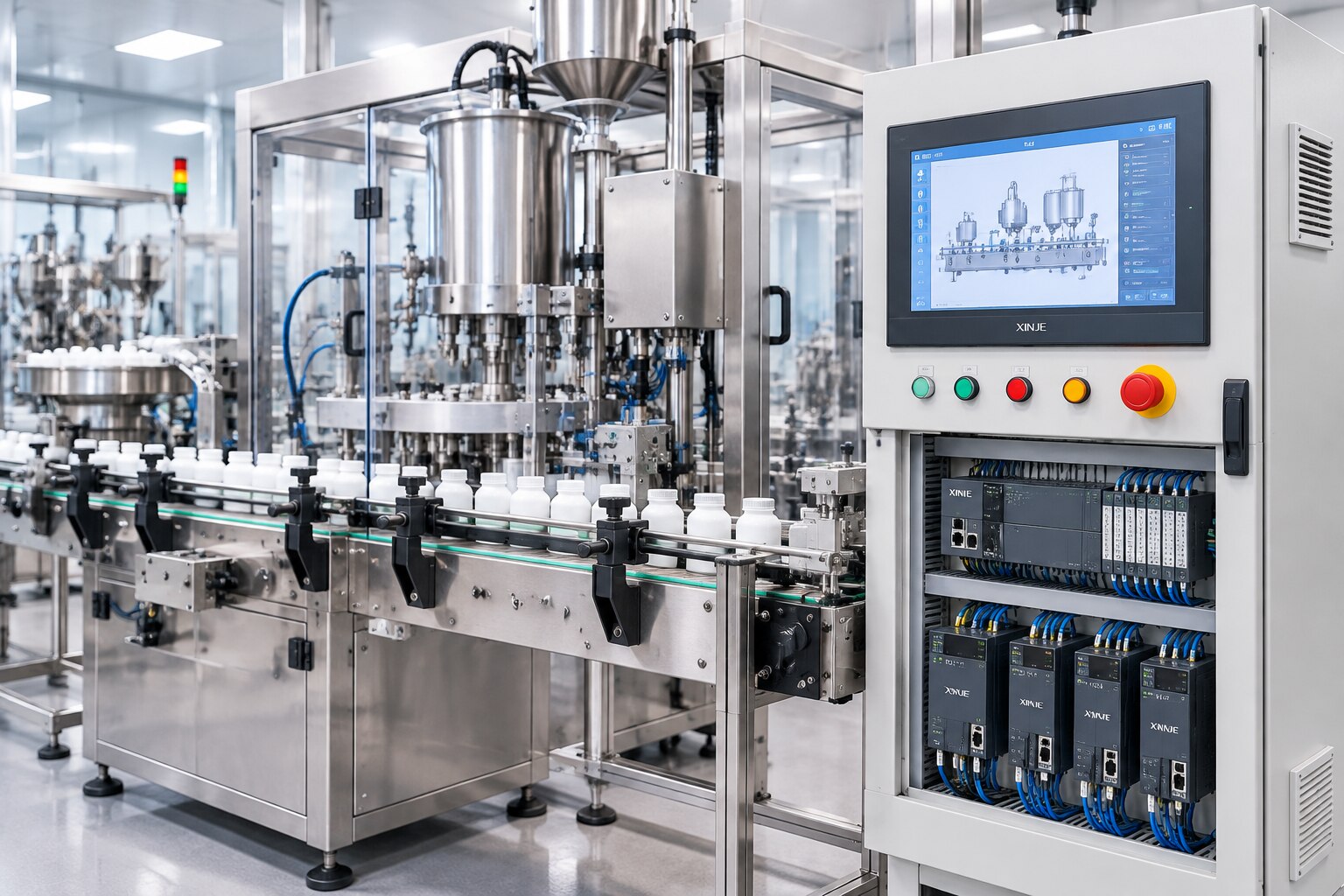
A pharmaceutical plant does not buy a PLC, HMI or I/O module in isolation; it buys a controlled system that must match the process, validation plan, plant environment and future support needs. By the end, you will know how to turn a process requirement into a component specification, compare quotations, verify compatibility and demand the records needed for commissioning and qualification.
Key takeaways
- Start with the URS and control narrative before choosing PLC or HMI hardware.
- Match components to process capacity, environmental conditions and required evidence.
- Compare Delta, Mitsubishi and Siemens by architecture, support and lifecycle fit.
- Demand separate FAT, SAT and validation records in every technical offer.
Start with the process, URS and control narrative
A pharmaceutical plant defines its automation need by describing the process and evidence required before selecting hardware. The User Requirements Specification (URS) states what the system must control, record and protect; the control narrative explains how each step, alarm and operator action works.
1. Map the process from material loading to cleaning and release. Identify critical process parameters such as temperature, pressure, pH, flow, speed and hold time, then define operating limits and required interlocks.
2. Write the URS for user roles, alarm priorities, electronic records, audit trails, data retention, recipe handling, interfaces and change-control expectations. State which records need timestamps, backup and review.
3. Convert the URS into a functional design specification (FDS). Describe sequences, permissives, equipment phases, manual modes, automatic modes, fault recovery and exception handling. For batch equipment, use the ISA-88 structure for recipes, procedures and equipment control.
4. Build the control narrative around cause and effect: when a condition occurs, what output changes, which alarm appears and what evidence is stored. This prevents a supplier from proposing pharma automation components based only on an attractive HMI demonstration.
Only then request industrial automation components for pharmaceutical plants in Bengaluru, along with the validation documents and support scope needed to prove the design works.
Build the component checklist around capacity and plant conditions
Specify the operating point before choosing pharma automation components: point count, processing speed, environmental exposure and documentation needs. Give an automation plc hmi component supplier a signed I/O list, control narrative and site-condition sheet, not just a preferred brand.
- PLC: CPU scan-time target, memory, safety or motion functions, expansion limit, firmware version and planned spare capacity.
- HMI: screen size, number of users, historian or recipe interface, audit-trail and access-role needs, communication ports, software licence and backup method.
- I/O: digital and analogue quantities, 24 VDC levels, 4–20 mA or RTD signals, intrinsically safe barriers, isolation, remote-I/O locations and spare channels.
- Network: protocol, managed-switch requirement, Ethernet topology, cable lengths, redundancy, time synchronisation and interfaces to drives, MES, historian or building systems.
- Power: 24 VDC load, inrush current, UPS-backed circuits, segregation, earthing and short-circuit protection.
- Enclosure: panel dimensions, heat dissipation, IP or NEMA rating, stainless-steel construction, cleanroom finish, washdown exposure and cable-entry method.
| Plant condition | Specification consequence | Risk if missed |
|---|---|---|
| Cleanroom or washdown area | Stainless enclosure and suitable IP rating | Corrosion or cleaning damage |
| Long machine layout | Remote I/O and managed Ethernet | Excess cabling and signal faults |
| Critical batch data | UPS, time sync, backups and audit-trail design | Lost records and revalidation work |
Compare Delta, Mitsubishi and Siemens by system fit
Compare them against complete lifecycle fit, not the invoice total. Select the platform that matches the URS, functional design specification, validation strategy, engineering skills and replacement plan. Delta, Mitsubishi and Siemens components are not one interoperable family: verify each PLC, HMI, I/O, drive and motion model, including protocol, electrical ratings, firmware and software version.
| Platform | System-fit questions | Cost or risk to expose |
|---|---|---|
| Delta | Does the proposed PLC, HMI and drive combination meet the required motion, diagnostics, Ethernet and remote-I/O functions? | Confirm software licences, local spares, firmware availability and migration options. |
| Mitsubishi | Does the controller family fit the machine’s motion, safety, network and engineer-support requirements? | Check programming-tool access, compatible modules and replacement availability for the exact series. |
| Siemens | Does the platform align with the plant standard, data architecture, diagnostics and validation documentation? | Price recurring licences, specialist engineering, obsolete modules and upgrade revalidation. |
Require a live demonstration of alarms, access roles, audit trails, backups and restore procedures—not only scan time or screen count. The quotation must identify source-code handover, software licences, spare-part recommendations, response times, cybersecurity controls and FAT/SAT evidence.
A lower-priced component loses its advantage if undocumented code, unavailable firmware or a platform change forces emergency redesign and revalidation.
Turn a supplier quotation into a comparable technical offer
A quotation is comparable only when it prices the complete control deliverable, not a PLC, HMI and I/O box. Require the automation PLC HMI component supplier to map every line to your URS and functional design specification.
- PLC CPU, firmware, I/O modules, spare channels and 24 VDC load
- HMI model, screen count, runtime or historian licences, user roles and audit-trail functions
- Communication hardware, protocol mapping, network topology and interface responsibility
- Panel fabrication, drawings, software configuration, backups and source-code handover
- Separate lead times for hardware, panel build, FAT, site mobilisation, SAT and qualification support
- Warranty, spare-part recommendation, lifecycle status, response times and change-control charges
For industrial automation components in Bengaluru, check whether “available” means stock in India or an imported CPU, specialty I/O, drive or network switch with a different lead time. Ask for anonymised FAT and SAT protocols, a traceability matrix, validation deliverables, deviation records and documented experience with the proposed PLC/HMI family.
A supplier’s brand list proves little. If you assess IkodeAutomation |08048033508, ask who owns the application source code, how backups are restored, and how the team handles firmware changes, obsolete modules and revalidation. Part 11 compliance belongs to the configured electronic-record system, not to the component label.
Related products
 | Industrial Automation Solutions & System Integration Pharma Industrial Automation System Smart, Reliable & Scalable Automation for Pharmaceutical Manufacturing Ikodeautomation is one of the best industrial automation solution providers... View product → |
 | Industrial Automation Solutions & System Integration Industrial Automation Component Sales Reliable Automation Components. Trusted Industrial Solutions.Ikodeautomation is one of the leading industrial automation component sellers and... View product → |
Separate FAT, SAT and validation evidence
A PLC or HMI is not accepted because it powers up. Purchase pharma automation components against separate FAT, SAT and validation evidence, with each gate written into the purchase order and project plan.
- FAT: Review the configured logic, I/O simulation, alarms, recipes, user roles, audit trails, reports, backups and failure responses at the supplier’s facility. Request the protocol and signed results.
- SAT: Verify wiring, network communication, I/O signals, instruments, interlocks and equipment operation after installation. Record punch-list items and deviations rather than treating commissioning notes as qualification records.
- Validation: Obtain IQ, OQ and PQ deliverables that trace the URS to the functional design, tests, results, deviations and approvals. A certificate of conformity does not replace this evidence.
Ask a supplier of industrial automation components for pharmaceutical plants in Bengaluru for anonymised FAT/SAT protocols, a traceability matrix, deviation records, firmware and software versions, manuals, backup files, source-code handover or escrow terms, and experience with the proposed PLC/HMI family. Confirm separate lead times for hardware, panel fabrication, software, FAT, site mobilisation and qualification support.
Do not label a component “21 CFR Part 11 compliant” by brand. Compliance depends on implemented access control, audit trails, time synchronisation, electronic records, backup, review and validation procedures. Accept only after the evidence matches your URS and change-control process.
Buy for replacement, modernization and lifecycle control
The purchase brief changes with the risk you are managing. A new machine needs a complete, validated control architecture; a failed part needs an exact, fast-compatible replacement; modernization needs a migration plan; standardization needs a platform decision that survives future expansions.
| Option | Purchase basis | Controls before ordering |
|---|---|---|
| New machine | Match the URS, I/O list, control narrative, capacity, network, spares and qualification evidence | Confirm PLC CPU, HMI, drives, software licenses, FAT scope and panel-build schedule |
| Failed-part replacement | Match the exact model, firmware, electrical ratings, protocol and terminal arrangement | Check obsolete status, backup availability, approved substitute and safe restart procedure |
| Line modernization | Preserve production while replacing weak or obsolete controls | Define cutover steps, temporary controls, source-code recovery, SAT, data migration and rollback |
| Platform standardization | Reduce engineering variation across machines | Compare Delta, Mitsubishi and Siemens components by diagnostics, programming environment, spare access, training and migration path |
For industrial automation components in Bengaluru, separate hardware lead time from panel fabrication, configuration, FAT, site mobilization and qualification support. Imported specialty I/O, drives and network hardware can delay a “locally available” project.
Do not treat Delta Mitsubishi Siemens components as interoperable. Verify exact model numbers, I/O characteristics, software versions, licenses, firmware compatibility and spare-part status. Add lifecycle controls: asset inventory, tested backups, controlled remote access, removable-media rules and a documented replacement path.
Frequently asked questions
What should a pharmaceutical plant define before selecting automation components?
Define the process in the User Requirements Specification, then document sequences, alarms, interlocks, operator actions, records and protection requirements in the control narrative.
How do you build a pharma automation component checklist?
List PLCs, CPUs, I/O, HMIs, networks, drives, instruments, panels, power supplies and spares against process capacity, expansion needs, temperature, humidity, washdown and hazardous-area conditions.
How should you compare Delta, Mitsubishi and Siemens components?
Compare each system by PLC and I/O capacity, programming environment, HMI and drive compatibility, communications, local support, spare availability and the plant’s existing architecture.
What should a supplier quotation include for a pharmaceutical automation project?
Request exact part numbers, quantities, firmware, technical specifications, panel scope, software scope, drawings, exclusions, delivery assumptions, FAT and SAT responsibilities, validation documents and warranty terms.
What is the difference between FAT, SAT and validation evidence?
FAT verifies the assembled system at the supplier’s site, SAT verifies installation and operation at the plant, and validation evidence records that the system meets approved pharmaceutical process and documentation requirements.
Related product
 | Component Sales and Services Siemens Industrial Automation Solutions IkodeAutomation provides professional Siemens Industrial Automation solutions for machine builders, OEMs, manufacturing industries and process... View product → |