
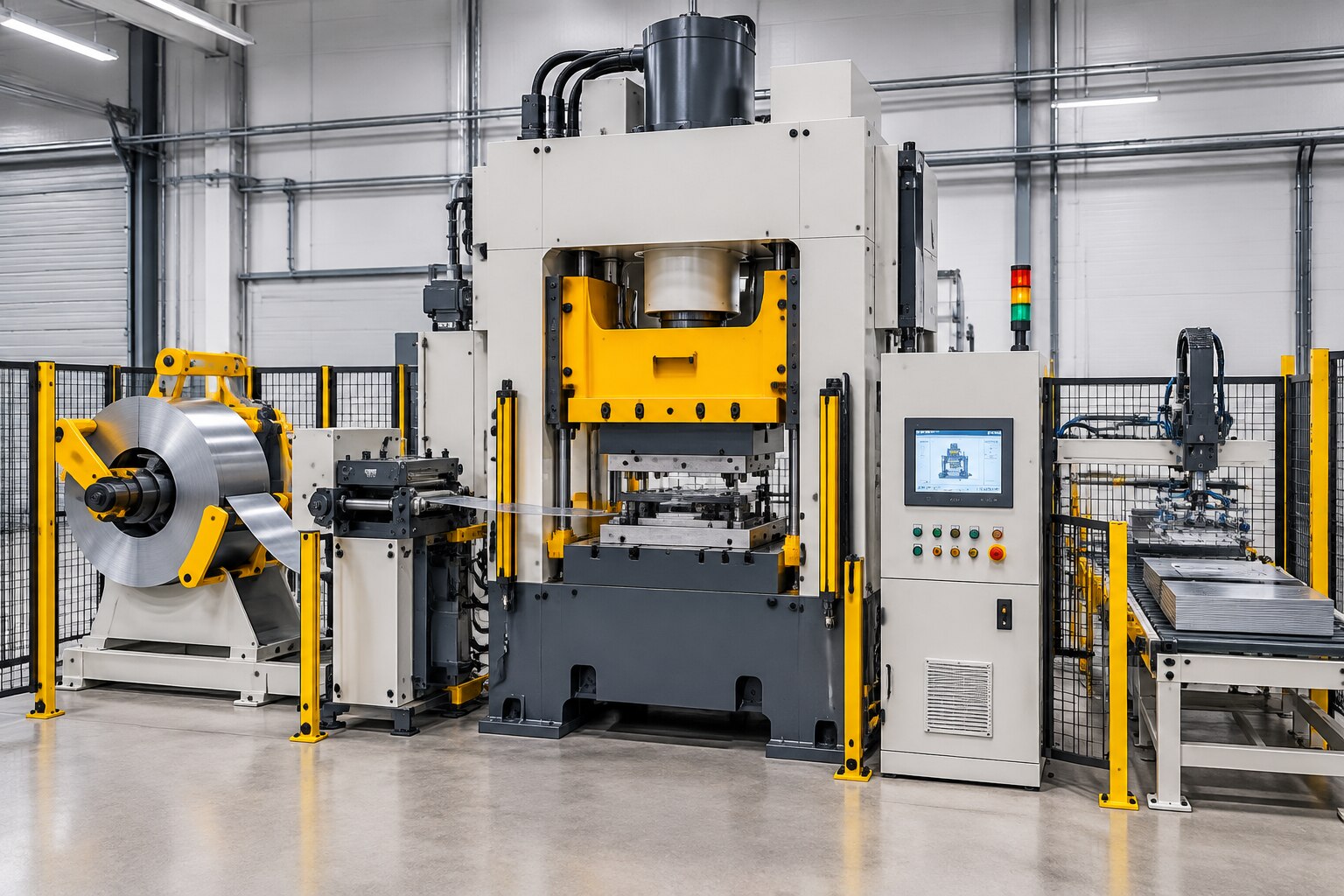
A press automation project succeeds only when the press, hydraulic or mechanical drive, feeder, transfer equipment, sensors and safety system operate as one validated cell. By the end, you will know what to specify, what information to give an integrator, when to retrofit, and how to compare quotations before approving the work.
Key takeaways
- Specify force, stroke, cycle time and material handling in the quotation brief.
- Choose a retrofit when the frame, drive and safety architecture remain serviceable.
- Require risk assessment, safety-circuit testing and documented cycle validation.
- Compare integrators on commissioning support, controls expertise and maintainability.
What hydraulic and mechanical press automation actually controls
A hydraulic press controls ram position, speed, force and dwell through the PLC, power pack, directional or proportional valves, pressure transducers and linear sensors. A mechanical press follows a crank-driven stroke, so automation must coordinate with the flywheel, clutch-brake, slide position and tonnage monitor.
For hydraulic press automation in Pune, specify isolation, pressure dissipation and prevention of unexpected ram movement during die changes, jam clearing and maintenance; stopping the pump is not enough.
Apply ISO 16092-3 to hydraulic presses and ISO 16092-2 to mechanical presses, then derive each safety function’s required performance level from the risk assessment under ISO 13849-1.
| Press type | What the machine controls | Typical application and constraint |
|---|---|---|
| Hydraulic | Variable stroke, speed, force and dwell | Forming, deep drawing, bending and jobs needing controlled force; slower cycles and greater flexibility |
| Mechanical | Fixed crank or eccentric stroke, clutch-brake timing and flywheel energy | High-speed blanking, stamping and progressive dies; limited stroke flexibility and strict transfer windows |
Mechanical press automation in Pune must release a blank, transfer a part or remove scrap only within the safe window established by the crank angle and guarded access envelope. Hydraulic systems give the integrator more freedom to pause or vary the ram, but stored pressure remains a maintenance hazard.
Automation commonly covers:
- Blank loading, strip or coil feeding and lubrication
- Die protection, gauging, ejection and transfer between dies
- Part unloading, scrap removal and palletising
What to automate and what to include in the quotation brief
Define the cell around the part flow, not the press tonnage. State whether it will load blanks, feed strip or coil, transfer parts between dies, lubricate, eject, remove scrap, gauge, unload or palletise—and give the required strokes per minute, batch size, part weight, orientation and changeover time.
Include these quotation inputs:
- Press make, model, year, tonnage, bed and bolster dimensions, daylight, stroke, shut height and ram-position feedback.
- Hydraulic power-pack pressure and flow, valve types, reservoir capacity, pressure transducers, cylinder details and the required force, speed and dwell profile.
- Die drawings, sensors, die-protection points, blank dimensions, material thickness, permissible misfeed and double-blank conditions.
- Feeder, robot or transfer reach, payload, gripper type, lubrication method, scrap route and pallet pattern.
- Guarding, access doors, light curtains, emergency stops and the risk-assessed PLr for each safety function under ISO 13849-1.
Use the machine type to set realistic timing and scope.
| Machine | Define in the brief | Cost consequence |
|---|---|---|
| Hydraulic press | Ram position, speed, force, dwell, residual-pressure isolation and unexpected-movement prevention | Safety valves, sensors and hydraulic modifications |
| Mechanical press | Crank angle, fixed stroke, clutch-brake response, flywheel, slide position and tonnage monitoring | Transfer windows and brake-monitoring interfaces |
Name the supply boundary: press OEM or integrator for the safety PLC, hydraulic safety valves, robot, feeder, guarding, software backups, spares and final validation. Require FAT and SAT criteria covering sustained cycles, part quality, fault recovery, safety trips, repeatable cycle time, alarm history, drawings and validation records.
That is the quotation brief for a hydraulic press automation system for integrators in Pune.
Retrofit or new automated cell: which route fits your press?
Retrofit the press when its frame, cylinders, guides, pump, valves and die space pass inspection, and replace it when structural wear, uncontrolled motion or obsolete controls make safe integration more expensive than a new cell.
Tonnage alone is not enough: check repeatability, leakage, ram-position accuracy, cycle time, guarding and available access for the robot or feeder.
| Option | Retrofit existing press | New automated cell |
|---|---|---|
| Cost and disruption | Lower equipment spend; shorter shutdown if the base machine is sound | Higher capital cost; longer installation and commissioning |
| Technical fit | Works when the press has usable sensors, serviceable hydraulics and space for guarding | Fits when stroke, force, speed, access or transfer windows no longer suit production |
| Safety | Add isolation, pressure dissipation and ram-movement prevention for die changes and jams | Engineer the complete safety architecture from the start |
| Controls | Resolve ownership of the press PLC, safety PLC, valves, HMI, backups and validation | Define one integrated controls and safety responsibility |
For hydraulic press automation in Pune, demand a documented residual-energy procedure; stopping the pump or relying on a relief valve does not safely isolate stored pressure. Apply ISO 16092-3 to hydraulic presses and ISO 16092-2 to mechanical presses, because clutch-brake, flywheel and crank hazards are not interchangeable with hydraulic hazards.
Mechanical press automation in Pune also needs transfer timing based on the fixed crank cycle, not tonnage. Require a risk assessment that sets each safety function’s PLr under ISO 13849-1, with validation to ISO 13849-2.
How the integrator should engineer and validate the press cell
Require a gated workflow: site survey, risk assessment, functional design, detailed engineering, factory acceptance test (FAT), site acceptance test (SAT), and production handover. For hydraulic press automation in Pune, record the press model, usable force-versus-stroke window, pressure and flow conditions, die dimensions, feeder pitch, dwell time, and material variation.
At the survey and design review, require written answers to these points:
- Identify whether the press OEM or integrator owns the safety PLC, hydraulic safety valves, die protection, guarding, robot and feeder controls, final validation, and spare parts.
- Specify software source-code access or escrow, PLC and HMI versions, network architecture, and responsibility for interface faults.
- Apply ISO 16092-3 to hydraulic presses; use ISO 16092-2 for mechanical presses. Do not transfer clutch, flywheel, or ram-position assumptions from a mechanical press.
- Derive each safety function’s required performance level (PLr) through risk assessment under ISO 13849-1, then validate the implemented circuit under ISO 13849-2. Do not label the entire cell “PL d” by default.
- Document isolation, pressure dissipation, and prevention of unexpected ram movement during die changes, jam clearing, and maintenance. Stopping the pump alone is not safe isolation.
- Define FAT and SAT tests for sustained cycles, part quality, misfeed and double-blank detection, power or air-loss recovery, guard trips, cycle-time repeatability, alarms, and access control.
Handover should include approved drawings, risk assessment, safety-validation records, alarm history, PLC/HMI backups, manuals, training records, and signed production results. This is the evidence a hydraulic press automation system for integrators in Pune must leave behind.
How to compare a press machine automation company in Pune
A dependable press machine automation company defines responsibility before it prices the cell. For hydraulic press automation in Pune, require a written boundary between the press OEM and integrator covering the safety PLC, hydraulic safety valves, guarding, die protection, feeder or robot controls, software source or escrow, spares, and final validation.
| Check | Dependable integrator | Warning sign |
|---|---|---|
| Machine basis | Uses ISO 16092-3 for hydraulic presses and ISO 16092-2 for mechanical presses | Treats both presses as interchangeable |
| Safety design | Assigns a risk-based PLr to each safety function under ISO 13849-1 and validates it under ISO 13849-2 | Promises blanket “PL d” or “PL e” |
| Energy control | Shows isolation, pressure dissipation and prevention of unexpected ram movement during die changes, jams and maintenance | Relies on stopping the pump or a relief valve |
| Process window | Proves force, pressure, flow, stroke, dwell, feeder pitch and transfer timing | Prices from rated tonnage alone |
Put acceptance tests in the purchase order:
- FAT: simulate sensor faults, guard opening, die misfeed, blank absence, overpressure and emergency stops.
- SAT: verify actual cycle time, transfer clearance, ram position, pressure-hold time, safe access and product quality at production rate.
- Handover: receive electrical drawings, PLC and HMI backups, risk assessment, validation records, manuals and spare-part lists.
Ask who responds on weekends, what response time applies, and whether remote diagnostics, operator training and preventive visits are included. IkodeAutomation |08048033508 can be evaluated against the same evidence rather than against a broad capability claim.
Related product
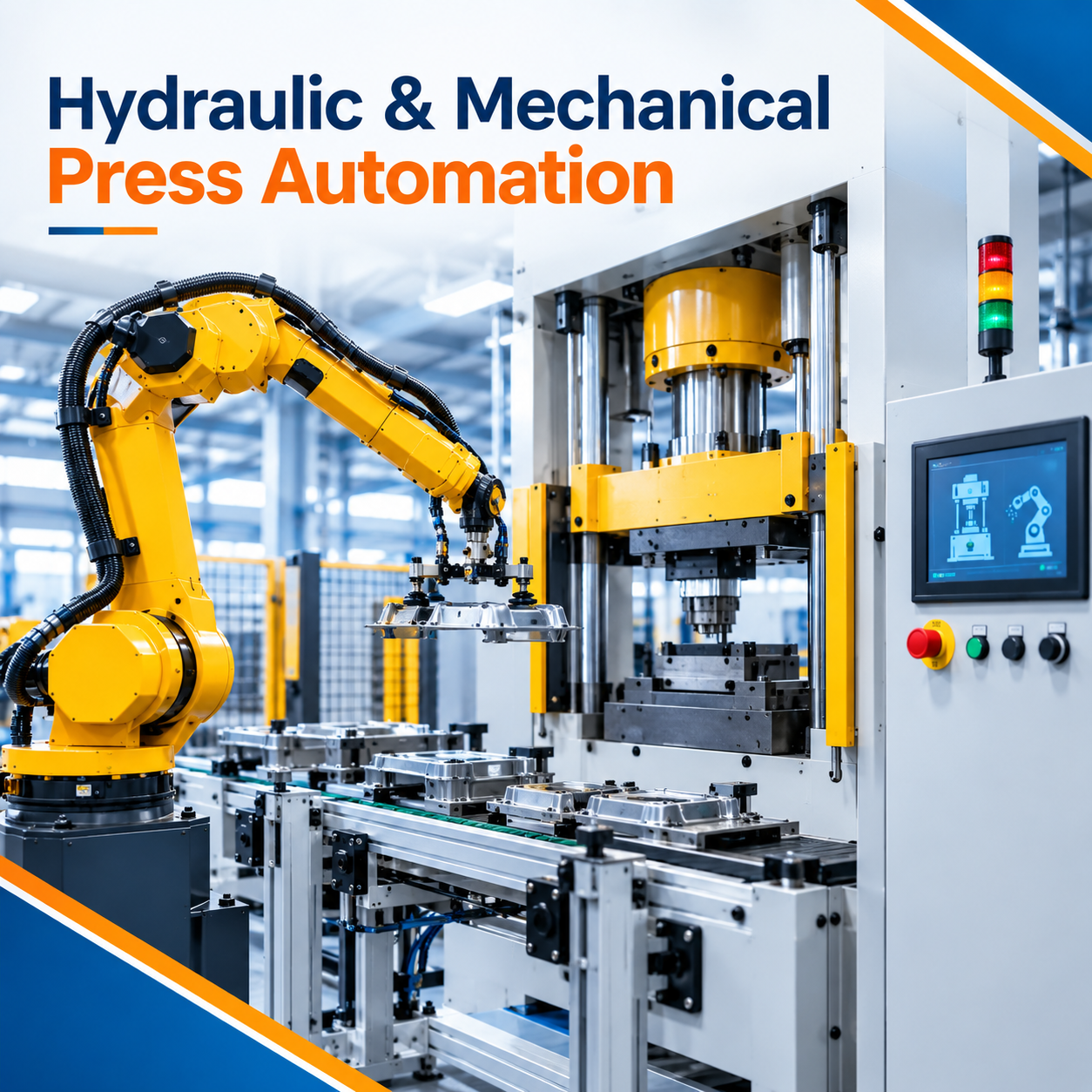 | Industrial Automation Solutions & System Integration Hydraulic & Mechanical Press Automation System Advanced Hydraulic & Mechanical Press Automation Solutions by IkodeAutomation Ikodeautomation provides customized Hydraulic & Mechanical Press... View product → |
Frequently asked questions
What does hydraulic press automation control?
It coordinates ram position, speed, force and dwell through the PLC, power pack, valves, pressure transducers and linear sensors.
How does mechanical press automation differ from hydraulic press automation?
Mechanical press automation must coordinate with the flywheel, clutch-brake, slide position and tonnage monitor because the crank determines the stroke.
What should you include in a press automation quotation brief?
State the press type, rated force, stroke, speed, cycle time, part dimensions, loading method, unloading method, quality checks, safety requirements and production target.
When should you choose a retrofit instead of a new automated press cell?
Choose a retrofit when the press frame, drive, controls, guarding and critical mechanical components can meet the required cycle, safety and maintenance conditions.