
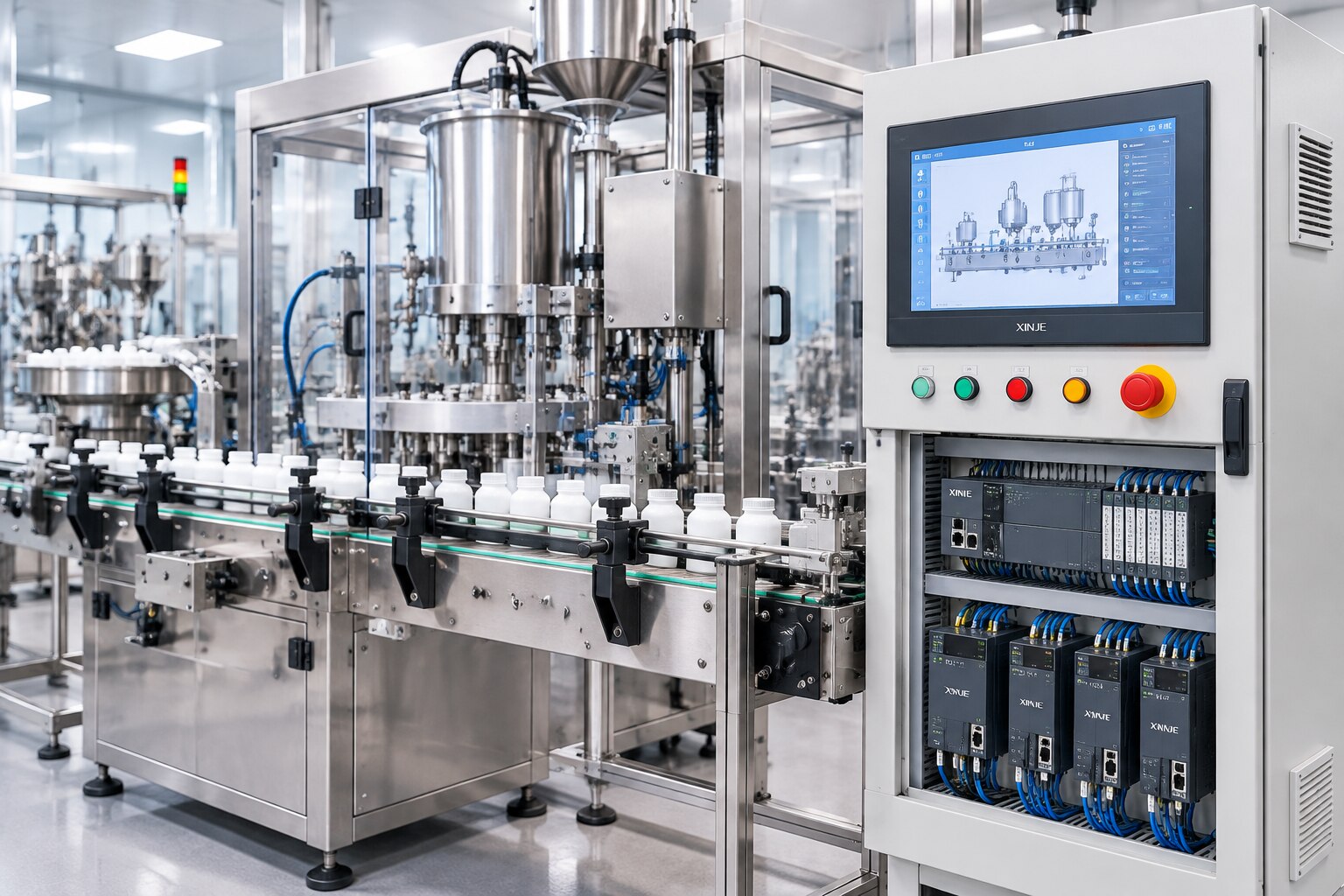
A pharma automation project covers far more than PLC programming: it defines process control, equipment interfaces, validation evidence, data integrity, cybersecurity and site acceptance. By the end, you will be able to turn each process stage into a measurable scope, identify the documents and tests required, and compare quotations without overlooking costly exclusions.
Key takeaways
- Price survey, design, testing, installation, qualification, training and support separately.
- Request URS, functional specifications, test records and qualification evidence before approval.
- List every PLC, HMI, SCADA, instrument, equipment and network interface.
- Require audit trails, electronic records, access controls, backups and cybersecurity testing.
What work packages take a pharma automation project from survey to support?
A pharmaceutical plant automation project covers more than PLC programming. It starts with a site survey and User Requirements Specification (URS), then moves through design, hardware, software, testing, installation, qualification, training and post-commissioning support. Price and schedule each package separately.
| Stage | Included work | Required output |
|---|---|---|
| Site survey and URS | Process walkdown, equipment interfaces, instrument locations, cleanability, utilities, server room, power quality, earthing and network assessment | Survey report, interface list and approved URS |
| Functional and detailed engineering | Functional specification, risk assessment, control narratives, loop drawings, cable schedules, panel layouts, sanitary connections, calibration ranges and certificates | Approved design, traceability matrix and design qualification |
| Hardware and site execution | Panels, PLC/PAC/DCS, HMI/SCADA, servers, switches, instruments, VFDs, load cells, transmitters, installation, cabling and termination | Inspection records, as-built drawings and installation qualification |
| Software and FAT | Recipes, sequences, alarms, user roles, audit trails, trends, reports, historian, time synchronisation, backups and network segmentation | Tested application and factory acceptance records |
| SAT, commissioning and qualification | Loop checks, network commissioning, site acceptance testing, IQ, OQ, PQ support and production cutover | Approved test records and handover dossier |
| Training and support | Operator and maintenance training, spare-parts list, recovery drill, defect correction and shutdown support | Training records, support plan and final documentation |
Define these exclusions before ordering:
- Civil and HVAC construction, cleanroom qualification, external-laboratory calibration and GMP SOP writing.
- MES, LIMS and cybersecurity-tool licences, utility metering and long-term managed support.
- Remote access, patching, removable-media controls and disaster recovery ownership.
Which documents prove that the system is designed and qualified for use?
The evidence is a controlled document trail, not a PLC programme alone. For a pharma industrial automation for system in Bengaluru project, the sequence starts with the user’s intended process and ends with reproducible operation under approved procedures.
- The site owner writes and approves the User Requirements Specification (URS), defining products, capacity, GMP functions, records, alarms, interfaces and acceptance criteria.
- The automation integrator converts the URS into the Functional Specification and detailed design; the owner reviews and approves them.
- The owner, integrator and quality unit assess risks, then link each requirement to a test in the Traceability Matrix.
- The design team completes Design Qualification (DQ) before fabrication, confirming that the proposed architecture and equipment meet the approved requirements.
- The integrator runs the Factory Acceptance Test (FAT) against an approved script using representative I/O, sequences, alarms, interlocks, reports and failure conditions.
- At site, Installation Qualification (IQ), Operational Qualification (OQ) and Performance Qualification (PQ) verify installation, functions and sustained performance. Commissioning records capture loop checks, calibration, wiring, network tests, training, punch-list closure and handover.
| Document | Primary owner | What it proves |
|---|---|---|
| URS | Site owner | Intended use and acceptance basis |
| Functional specification | Integrator, approved by owner | Implemented control functions |
| Risk assessment and traceability matrix | Joint team, quality-approved | Risks controlled and requirements tested |
| DQ, FAT, IQ, OQ and PQ | Quality-led owner with integrator support | Design, factory, installation, operation and process performance |
| Commissioning records | Site engineering | Installed system is ready for qualified use |
How should you choose the control architecture and list every equipment interface?
Choose the architecture by control responsibility, not by brand. A pharma PLC HMI SCADA system normally uses field instruments for measurement, PLCs or PACs for deterministic sequences and interlocks, HMI screens for local operation, and SCADA for alarms, trends, historian records, recipes and reports.
| Option | Role | Best fit |
|---|---|---|
| PLC | Fast logic, sequencing, interlocks and equipment control | Individual machines and skids |
| PAC | PLC control plus larger data handling and coordinated motion | Complex process cells and multi-unit batches |
| DCS | Distributed continuous control, regulatory loops and plant-wide operations | Large utilities or continuous production |
| SCADA | Supervisory visualization, alarms, trends, historian and reports | Site-level monitoring and batch oversight |
| BMS | HVAC, room pressure, temperature and humidity supervision | Cleanrooms and building services |
Separate equipment control from procedural batch management using ISA-88 phases, equipment modules and recipes. Record the protocol, tag name, unit, quality code, timestamp owner, update rate, store-and-forward rule and link-failure response for every external connection; OPC UA alone does not define GMP data ownership.
List each interface before design approval:
- Dispensing: load cells, barcode readers, printer, dust extraction and access interlocks.
- Granulation: impeller drive, chopper, spray pump, temperature, pressure and endpoint signals.
- Drying: inlet and outlet temperature, humidity, airflow, fan VFD and filter differential pressure.
- Blending, compression and coating: motors, torque, speed, load cells, tablet press, spray system and exhaust.
- Filling and sterilization: fill pumps, level, temperature, pressure, recipes, autoclave valves and cycle records.
- Packaging: conveyors, servo drives, vision, checkweigher, barcode and reject confirmation.
- Utilities and material handling: HVAC, purified water, WFI, clean steam, gases, chilled water, boilers, wastewater, lifts and conveyors.
What regulated functions, tests and cybersecurity controls must the system provide?
A regulated system must control the process and prove what happened. Define recipe versioning, sequence permissions, alarm limits, interlocks and recovery steps for temperature, pressure, flow, level, humidity and equipment status. Capture electronic batch records, reviewable audit trails, trends, reports and historian data with synchronized timestamps, defined retention and retrieval.
Require these tests before release:
- FAT verifies recipes, sequences, alarms, reports, interfaces, user roles and audit-trail behavior against approved specifications.
- SAT confirms installed instruments, panels, networks, tags, alarm annunciation and equipment communication at the plant.
- IQ confirms installation and configuration; OQ challenges operating ranges, interlocks, access controls, power loss and communication-loss recovery.
- PQ demonstrates repeatable batches under defined minimum and maximum process conditions, correct record capture and report reconciliation.
- Backup and restore testing proves that servers, configurations, recipes and historical records return to service without silent data loss.
Data integrity controls need unique accounts, role-based access, controlled configuration changes, secure audit trails and documented record retention. The validation package should show who may create, approve, execute or alter a recipe.
Cybersecurity belongs in the same scope. Segment controllers, HMIs, servers and business systems; document firewall rules; control remote access and removable media; maintain an asset inventory, patch and antivirus plan, isolated backups and disaster-recovery procedures. The same acceptance standard applies to pharmaceutical automation solutions in Bengaluru.
What should a Bengaluru automation quotation include before you approve it?
A quotation is ready for approval only when it itemises site work, hardware, software, documents, acceptance tests, support and exclusions—not just PLC programming and a lump-sum price.
1. Confirm site engineering: survey, panel and server-room design, cable schedules, loop drawings, instrument installation, earthing, power-quality checks, network commissioning and production cutover support in Bengaluru.
2. Specify panels and field devices by quantity and make: PLC, HMI, SCADA servers, VFDs, instruments, load cells, transmitters, barcode readers, checkweighers, switches, UPS units and spare I/O.
3. Name every interface and protocol, including HVAC, purified water, clean steam, packaging machines, MES, LIMS and utility meters. State who supplies licenses, gateways and cabling.
4. Attach the document register: URS, functional specification, risk assessment, design qualification, traceability matrix, FAT, SAT, IQ, OQ, PQ, commissioning records, as-built drawings, backups and instrument certificates. Assign document ownership.
5. Define FAT and SAT scripts. Test representative I/O, recipes, alarms, permissives, failure recovery, reports and interfaces at FAT; verify wiring, calibration, networks, utilities and plant procedures at SAT.
6. Set measurable acceptance criteria: batch repeatability, data capture, report reconciliation, access control, alarm response, power-loss recovery and backup restoration at defined process limits.
7. Price training, spare-parts lists, cybersecurity inventory, segmentation, firewall rules, remote access, patching, removable-media control, recovery drills and post-commissioning support separately.
8. List exclusions by name: civil/HVAC work, cleanroom qualification, external-laboratory calibration, GMP SOPs, process validation, MES/LIMS licences, cybersecurity tools, utility metering and long-term managed support.
Assess a pharma automation integrator such as IkodeAutomation |08048033508 by scoring its quotation against each line, named owner, deliverable, date and change-order trigger.
Related products
 | Industrial Automation Solutions & System Integration Pharma Industrial Automation System Smart, Reliable & Scalable Automation for Pharmaceutical Manufacturing Ikodeautomation is one of the best industrial automation solution providers... View product → |
 | Industrial Automation Solutions & System Integration Turnkey Industrial Automation Projects Complete Automation Solutions from Concept to Commissioning- Ikodeautomation is one of the best industrial automation solution providers for turnkey... View product → |
Frequently asked questions
What work packages are included in a pharma automation project?
The scope runs from site survey and URS through design, hardware, software, testing, installation, qualification, training and post-commissioning support. Price and schedule each package separately.
Which documents prove a pharmaceutical automation system is designed and qualified?
Request the URS, design specifications, functional specifications, hardware and software drawings, interface list, factory and site acceptance test records, installation and operational qualification records, change history and training records.
How should you choose a pharma PLC, HMI and SCADA architecture?
Choose the architecture from the URS, process criticality, required availability, data-retention needs and maintenance model. Document every equipment, instrument, PLC, HMI, SCADA, network and system interface.
What should a Bengaluru pharma automation quotation include?
Require itemised hardware, software, engineering, testing, installation, qualification, training, travel, spares, support, exclusions, assumptions, milestones, acceptance criteria, payment terms and warranty coverage.
Related product
 | Industrial Automation Solutions & System Integration Secondary Packaging Automation System Automated Secondary Packaging Solutions Ikodeautomation provides customized Secondary Packaging Automation solutions for manufacturing and packaging... View product → |